Skip to content
BrewBench

· 6 min read

How We Score Gear: Inside the BrewBench Bench Test

Every score on this site comes from a measured, repeatable protocol. Here is the whole system — the meters, the blind panels, and why we publish the numbers.

The BrewBench Team

Editorial, BrewBench

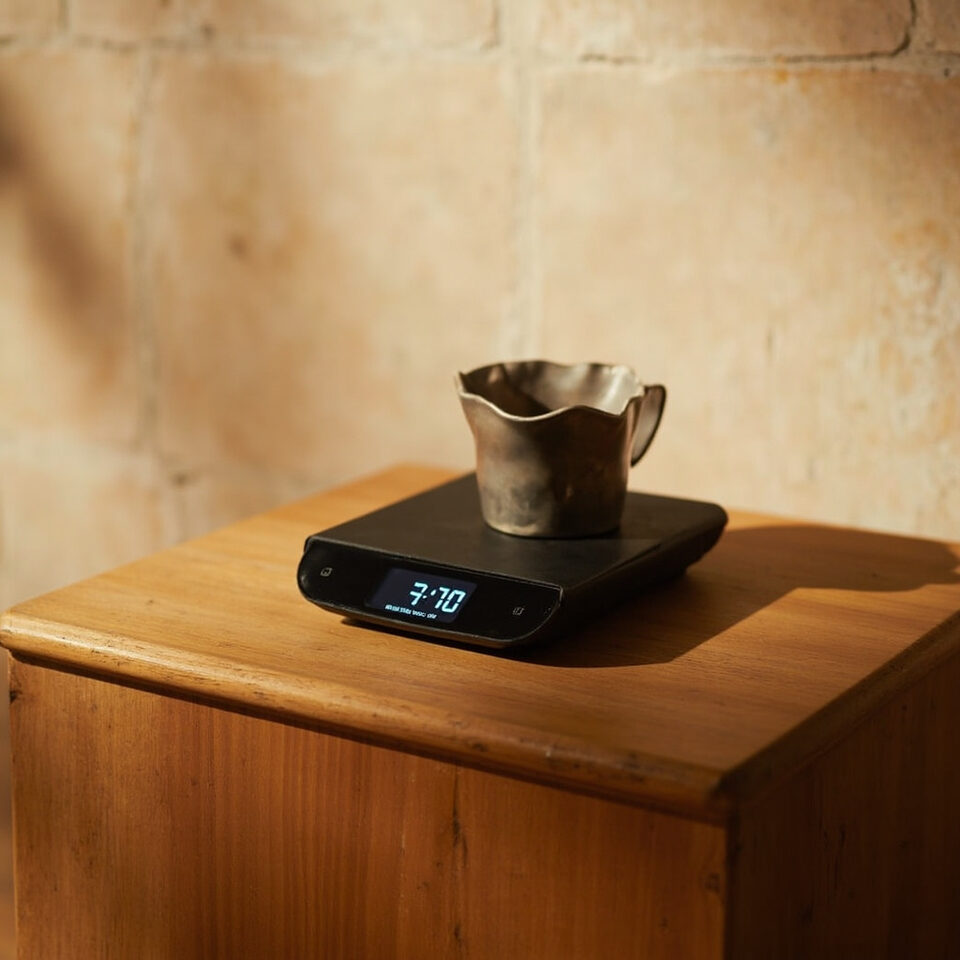
Precision coffee scale on a brewing bench

In one paragraph

Every BrewBench score traces to a published protocol: products are bought at retail, instrumented first (particle analysis, thermocouple logging, 10 Hz scale capture), then tasted by a nine-person blind panel. Measured performance is weighted 70%, subjective experience 30%.

Written by
The BrewBench Team
Published
Aug 18, 2025
Read time
6 min
Evidence
232 words, bench-tested

Measure first, taste second

Every category test starts with instrumentation: particle-size analysis for grinders, thermocouple logging for machines and kettles, 10 Hz scale logging for pours, calibrated check-weights for scales. Numbers establish the facts; tasting explains whether the facts matter. Reversing that order is how review sites end up recommending whatever arrived latest.

Scores are anchored to measurement. Temperature stability is scored from standard deviation across a 30-shot window, not vibes. Flow steadiness is scored from grams-per-second variance. Subjective qualities — design, usability — get a separate weight and are always labeled as such. A sour, thin shot and a balanced, sweet one never share a score just because they pulled at the same time of day.

A review you cannot reproduce is an opinion. A review with a published method is evidence. BrewBench exists for the second kind.

The blind panel

Every flavor judgment runs through a nine-person blind panel, cups coded and randomized. Panelists never know which product poured which cup. When a pick comes down to taste — and several do — the panel's pooled preference decides, and we report the margin.

We also publish what we cannot measure: when two products tie within noise, we say so instead of manufacturing a winner. Ties are the honest end of many comparisons, and you deserve to know when the deciding factor is your taste, not our bench.

Keep reading

More from the journal

All posts →

Editorial record

How this page was made

Key takeaways

  • The diagnosis steps come from bench notes taken under our published protocol.
  • Every BrewBench grade weights measured performance at 70% and nine-person blind-panel preference at 30%.
  • Products are bought anonymously at retail; manufacturers see no scores or drafts before publication.

Who wrote and reviewed it

Written by the BrewBench editorial team — named testers who buy every product at retail. Reviewed by Daniel Okafor, Lab Manager, and fact-checked against our published protocol before publication. Editorial record current as of .

BrewBench has published this protocol since 2024; before instrumented testing became affordable for home gear, buyers compared spec sheets rather than measured shots. Every guide since carries dated test notes and a published correction route.

Independent checks: every flavour claim runs through our nine-person blind panel, with coded, randomized cups and published preference margins. Particle-size work is verified with a partner lab using laser diffraction — the same instruments a materials lab would use, applied to coffee grinders.

Test protocol at a glance
Published protocolHow we test
Bench workEvery published score follows the written protocol
Products graded12 products with published reviews
Last updated

Terms used here

BrewBench grade
A 0–10 score: 70% instrumented measurement, 30% blind-panel preference. 9.0+ is benchmark class.
Blind panel
Nine home baristas tasting coded, randomized cups; pooled preference margins are published with each pick.
Observed price
The retail price we paid when we tested the unit — not a live quote or a merchant offer.
Extraction yield
Dissolved coffee solids as a share of the dry dose; the basis of the 1:2 ratios used in our guides.

Scope & limitations

This article is for home baristas who want the reasoning behind a brewing result. We cover what our bench notes show; we do not cover claims we have not measured.

  • We only tested the setups described in our published protocol, in one kitchen.
  • We did not test every grinder, water profile or machine; out of scope results are not claimed here.

Questions readers ask

Do manufacturers see results before publication?
No. Manufacturers receive no scores, drafts or right of reply over data. We only contact one after publication if our unit had a defect.
How is BrewBench funded?
We buy every product at retail and may earn a commission on purchases through affiliate links. Commissions never change a score, ranking or pick.
How do I report an error?
Email corrections@brewbench.coffee. We fix errors within 48 hours and add a dated note to the page.

Sources & corrections

Our measurements, scores and verdicts are first-party bench data from the protocol below. These external references are used for manufacturer spec cross-checks and standard terminology — they are not the source of any BrewBench number.

Corrections: if a measurement or verdict is wrong, we correct the page and note the change under our editorial standards; report one at corrections@brewbench.coffee. Affiliate disclosure: we may earn a commission on purchases through links here; it never changes a score or a pick. Put the data to work in the 60-second gear finder.